Llibert Fortuny i Cendra 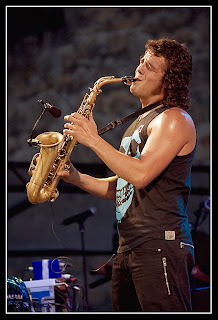
Llibert Fortuny i Cendra
Born in Las Palmas de Gran Canaria, born shortly after he moved with his family to Catalonia where his parents are from. Finishes his studies from secondary Classical Music with Toni Vidal, the season 96-97. He also attends classes with James Badrena Modern Music. When he finished his studies in 1997 at the Music Conservatory of Manresa, is awarded by the Berklee College of Music with a European scholarship. In Boston he studied with Shannon LeClaire, Ed.Tomassi, Hal Crook, Phil Wilson, Greg Hopkins, Ken Cervenka and Bill Pierce, among others.
In 2001 he returned to the United States to Barcelona and founded his first band, "Fortuny Quartet Llibert" incorporating the same to excellent musicians such as David Mengual on bass, Albert Bover Miralta on piano and Marc on drums. With that training he recorded his first album entitled: "A circus without lions" New Media in 2004 and has the support of Perico Sambeat the alto and soprano. Earlier in 2002 he received the award for best jazz musician in the Jazz Musicians' Association of Catalonia and modern music. Again in 2004 received a major boost in his career when he was named by the critics, best interpreter of jazz awarded the Porret Puig. Lately, he has played in the Boston scene. The style of the quartet was collected from bebop to hard bop with influences of the cool period. Live interpret their own versions of standards and songs.
currently still looking for new ways to address their training, "Llibert Fortuny Electric Quartet" a group formed by David Soler (guitar), David Mengual (bass), Daniel Dominguez (drums) and Chem Puigtio (sound and effects). With that training he performed in jazz festivals in Terrassa and Barcelona and was Resson winning Jazz Circuit held in autumn 2004. Llibert Fortuny is a great reality of the English jazz and has an impeccable technique and a strong sound. Web
Llibert Fortuny
Historia de la Bateria 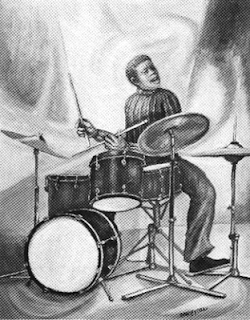
Battery born in early S. XX. The main constituent elements (drum, box, dishes, ...) existed in classical orchestras and military fanfares. The appearance of the battery is directly connected with the emergence of Jazz, although the technology gap that existed at the beginning of the century.
Towards 1910 in United States, the orchestra played with 3 and 4 percussionists (one for the box, one for the kick and the other for different items such as dishes, Chinese boxes, etc..) Or only two if played fanfares. The invention of the box and walk mostly hype foot (marketed in 1910 by Ludwig) can assemble the different elements to be touched for less than instrumentalists. The arrival of Ragtime and the need of musicians for the dance halls, make it necessary to finish the assembly of the battery, where one performer played all the above elements.
At this time, the role of the battery was to follow and keep pace with fanfare, but with a style Music is very similar to military marches, drummers drum rudiments used the classic but with a different phrasing, directly inspired by the orchestras of stops (rolls less rigid, syncopation and accents in just the first time.
História del saxofón 
The saxophone is a conical instrument of the family of woodwind instruments, usually made of brass and consists of a single reed mouthpiece like the clarinet. It was invented by Adolphe Sax in 1846. The saxophone is commonly associated with popular music, big band music and jazz, but was originally designed as for the orchestra where they are located behind the flutes, and a military band instrument. Interpreters are called instrument saxophone or sax, but the last word used to describe the same way the instrument.
The saxophone was created in the early half of 1840 by Adolphe Sax, an instrument maker and clarinetist born in Dinant (Belgium) working in Paris, and came out officially Patent 1846 (which was granted May 17). Made 14 different types of saxophones. Sax's amazing ability to offend rival instrument manufacturers and the unfortunate prejudices of her character and instruments led that the saxophone was not used in orchestras, relegated for a long period of military bands, despite his close friendship with some influential Parisian composer Berlioz.
is unknown the origin of the inspiration that led him to create the instrument, but there is clear evidence that points to fit a clarinet mouthpiece to a Figl using the keys of the oboe as the most likely source (no doubt this leads to a sound like a saxophone). Sax worked in the studio of his father for many years, and it produced both clarinets as Figl. The tarogato Hungary and Rumania, which is quite similar to the soprano saxophone, has also been reported as a possible inspiration. However, this can not be because the modern tarogato has a nozzle of a cane was not developed until 1890, long after the invention of the saxophone. Most likely, however, is that Sax actually try to create an entirely new instrument which suited both tonally and technically with the idea I had in mind and had a new level of flexibility. This explains that he chose to name the instrument as the "voice of Sax."
The development is defined almost entirely in terms of Sax's patent. During the term of the patent (1846-1866) no one except the Sax factory could legally Paris manufacture or modify the instrument. After 1866 he introduced many changes that took place several manufacturers.


